
IEC 60335 Appliance Safety Testing — How the Clauses Map to Test Equipment.
Most of the standards discussed on these pages describe test hardware. IEC 61032 standardises probes, IEC 60695 standardises flame and glow-wire apparatus, and what they define can be picked up and calibrated. IEC 60335, Household and Similar Electrical Appliances — Safety, is the opposite kind of document. It is a product safety standard and standardises almost no equipment of its own. It states requirements: protection against electric shock, fire, mechanical and thermal hazards, and the durability of whatever holds those protections in place over the product's life. Then it points at the apparatus standards that supply the means of checking them. For a laboratory, 60335 is therefore less a test method than a programme: a set of references into IEC 60695, IEC 60112, IEC 61032 and IEC 60529, plus a handful of mechanical endurance rigs that the standard effectively defines itself. This article is a map of that programme; stations that already have a detailed article on this site get a couple of sentences and a pointer.
One general part, a hundred particular sheets
IEC 60335-1 carries the general requirements that apply to every appliance in scope. The IEC 60335-2 series, more than a hundred documents, adapts them per category: kitchen machines, heating appliances, motor-operated tools, vacuum cleaners and so on. A product is never assessed against Part 1 alone: the assessment reads Part 1 together with the relevant Part 2-xx, the particular part inheriting the general clauses and modifying them where the appliance type demands it. When a datasheet says a product is tested to IEC 60335, it always means that combination, never a single document.
The clause numbering survives the inheritance, which is what makes the family navigable. Clause 21 is mechanical strength, clause 23 internal wiring, clause 25 the supply connection and external flexible cords, in Part 1 and in every particular part built on it. Where a Part 2 needs a test of its own, it appends new sub-clauses inside the inherited structure. The vacuum-cleaner part, IEC 60335-2-2, adds a current-carrying hose bending test as clause 21.103 — inside the mechanical strength clause it took over from Part 1. An engineer who knows the Part 1 skeleton can find their way around any particular part.
Scope, briefly: household and similar use, extending into light commercial settings such as shops, offices and farms, for appliances supplied from the mains or a battery within the voltage limits Part 1 defines. The standard checks behaviour under normal use and under reasonably foreseeable misuse. That second phrase pulls abnormal-operation and simulated-fault testing into the programme alongside the normal-duty checks.
Cords and hoses: the rigs 60335 defines itself
Start with the part of the programme that borrows nothing. Clauses 23 and 25 contain endurance tests in which a conductor assembly is flexed repeatedly under load to prove it survives years of handling. Clause 23.3 flexes internal wiring; clause 25.14 flexes the supply cord at the appliance inlet. The pass question is the same in both: do the conductors and the insulation withstand repeated flexing without breaking and without exposing live parts.
For 25.14 the standard also fixes the arrangement, which corresponds to its Figure 8: the cord is flexed back and forth under a defined load for the required number of cycles, confirming the durability of the cord and its anchorage — the point where real cords actually fail.
Particular parts add their own variants. IEC 60335-2-2 clause 21.103 is the vacuum-cleaner case: the current-carrying hose is bent through repeated cycles to verify that hose and conductors survive the bending of normal use without breaking or creating a safety hazard.
No apparatus standard exists for any of this; the rig is implied by the clause. This is where appliance testing turns into custom test engineering, and it is the corner of the 60335 programme where ULMEKA's catalogue answers clause by clause: a cord flexing device for clauses 23.3 and 25.14 with adjustable bending angle, speed and programmable cycle count; a 25.14 Figure 8 bending tester whose bending force adjusts between 5 N and 100 N; and a hose bending device built around clause 21.103 of the 2-2 part. Each machine exists because one clause in one part of one standard asks a question no general-purpose tester answers.
Heat and fire resistance through the IEC 60695 family
For resistance to heat and fire, 60335 does the opposite and borrows everything. The thermal stability and ignition behaviour of non-metallic and insulating parts are assessed with apparatus drawn from IEC 60695, the fire hazard testing series — the same methods called up by IEC 60598 for luminaires, IEC 60884 for plugs and socket-outlets and IEC 60601 for medical equipment.
Glow wire
The glow-wire family simulates the heating effect of an overloaded connection or an overheated component: a wire tip heated to a set temperature, commonly between 550 °C and 960 °C, is pressed against the specimen at about 1 N. IEC 60695-2-10 defines the apparatus, -2-11 the end-product test, -2-12 and -2-13 the GWFI and GWIT material indices. The glow-wire article here covers device and procedure in detail.
Needle flame
IEC 60695-11-5, which has its own article on this site, covers the other ignition scenario: a small flame from a failed component rather than a hot surface. A needle burner with an outer diameter no greater than 0.9 mm produces a 12 mm test flame, applied to the specimen for a set time to see whether parts ignite and how flame and burning particles propagate.
Ball pressure
Ball pressure, to IEC 60695-10-2, checks that an insulating material does not soften unacceptably at operating temperature. A 5 mm steel ball is pressed into the surface at 20 N while the sample is held for one hour at a set temperature, typically 125 °C or 200 °C; the indentation left behind must not exceed 2 mm in diameter.
What the CTI figure measures
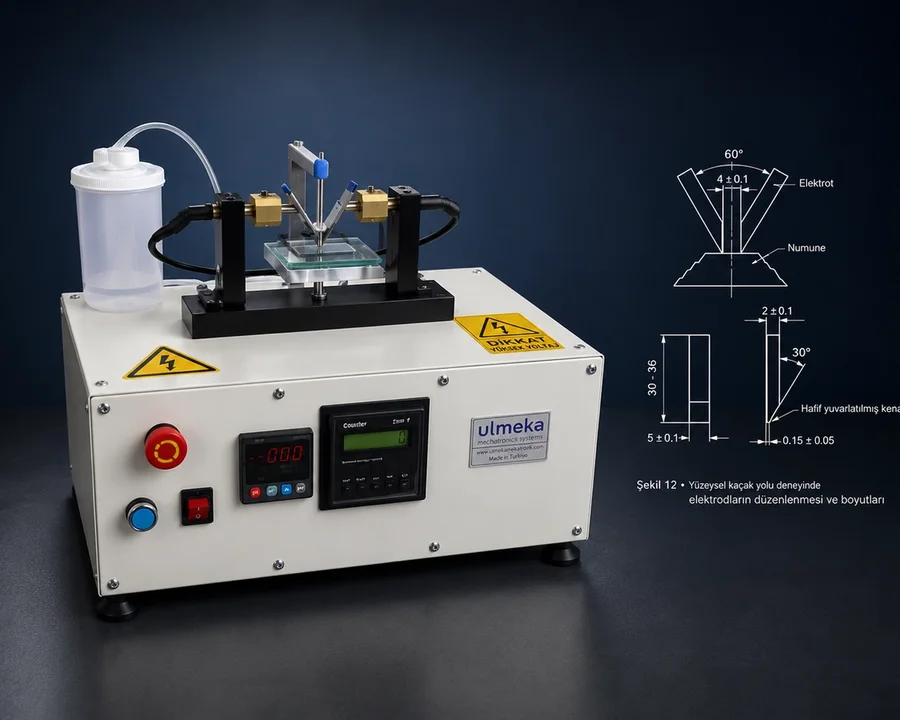
Tracking is the slow failure mode of insulating surfaces. Moisture and contamination let small currents flow across the surface, and over time those currents carbonise a conductive path that can end in a short circuit or a fire. IEC 60112 quantifies a material's resistance to this as the comparative tracking index: drops of a defined electrolyte fall between two electrodes on the material surface while voltage is applied, and the CTI is the highest voltage at which the material survives 50 drops without forming a track. A proof tracking index (PTI) variant confirms a required class instead of searching for the maximum.
Product safety standards use the figure by setting a minimum CTI for insulation used at particular voltages or in particular pollution conditions. One planning note: CTI characterises a material, not a finished appliance; the test belongs to material selection as much as to type approval, and the value is often already on the material datasheet. The laboratory hardware is a tracking-index apparatus controlling electrode voltage, drop count and the interval between drops.
Access protection with the IEC 61032 probes
Protection against electric shock is partly an insulation question and partly a geometric one: can a finger, a tool or a wire reach a live part. The geometric half is tested with the standardised probes of IEC 61032. The jointed test finger — probe B, defined in clause 6.1.2.b, Figure 2 of that standard — is the most recognisable object in appliance testing. Probe 11, the force-adjustable finger applied at 10 N to 75 N, recurs through EN 60335-1 and its particular parts; probes 12 and 13 stand in for tool access, and probes 18 and 19 for the reach of children. The probe, the application force and the openings to be tried all come from the clause invoked. The IEC 61032 article on this site walks through the full probe set and what each one verifies.
If the appliance claims an IP rating
Dust and water claims are verified to IEC 60529, the IP Code. The first numeral's access checks and its solid-object levels up to IP4X use the same IEC 61032 probes; dust levels IP5X and IP6X need a dust chamber. The second numeral calls for its own hardware: drip boxes for IPX1 and IPX2, oscillating-tube or spray equipment for IPX3 and IPX4, calibrated jet nozzles and immersion tanks further up the scale. IP testing is a programme of its own and is treated that way in this site's IP articles.
Reading a 60335 test plan
A few habits that keep an appliance programme orderly:
- Find the Part 2 first. Until the applicable Part 2-xx is identified the programme is unknown; the particular part decides which general clauses apply unchanged and which are modified or extended.
- Sort the equipment list into borrowed and native. Most stations point at an apparatus standard: fire apparatus from IEC 60695, tracking apparatus from IEC 60112, probes from IEC 61032, IP equipment under IEC 60529. The flexing rigs of clauses 23 and 25 and additions such as the 2-2 hose bend are native to 60335 and usually built to the clause.
- Take severities from the clause, not from the apparatus. A glow-wire device covers a wide temperature range; the temperature for a given product comes from the applicable clause and part, as do forces, currents, durations and cycle counts.
- Plan for abnormal conditions as well as normal duty. 60335 examines temperature rise and behaviour under simulated fault conditions in addition to rated load; that affects scheduling and instrumentation.
- Follow the pointers. Glow-wire, needle-flame, the IEC 61032 probes and IEC 60884 plug-and-socket testing each have a dedicated article here; this page shows where they sit on the 60335 map rather than repeating them.
Where ULMEKA fits
ULMEKA Mechatronics manufactures equipment on both sides of that divide. On the borrowed side: glow-wire, needle-flame, ball-pressure and burner-flame apparatus from the IEC 60695 family, tracking-index test devices to IEC 60112, and the IEC 61032 access probes used in shock-protection and IP work. On the native side: the clause-specific machines, from the clause 23.3 and 25.14 cord flexing device to the 25.14 Figure 8 bending tester and the IEC 60335-2-2 clause 21.103 hose bending device, each built around the geometry, load and cycling its clause prescribes. A programme that starts from a Part 2 and a clause list converts naturally into an equipment list. The clause-built rigs are the items to settle early: bending angle, load and cycle count are cheap to settle on paper and awkward to change in steel.
Sistemas de ensayo relacionados.
Sistemas de ensayo →
Preguntas frecuentes.
What is the difference between IEC 60335-1 and the IEC 60335-2 series?
IEC 60335-1 carries the general safety requirements that apply to every household and similar appliance in scope. The IEC 60335-2 series, more than a hundred particular parts, adapts those requirements per appliance category. A product is always assessed against Part 1 together with the relevant Part 2-xx; the particular part inherits the general clauses, keeps their numbering and modifies or extends them where the appliance type demands it.
Does IEC 60335 define its own test apparatus?
Mostly no. For heat, fire, tracking, access and moisture it points to apparatus standards: glow-wire, needle-flame and ball-pressure equipment from IEC 60695, tracking-index apparatus from IEC 60112, test probes from IEC 61032 and IP equipment under IEC 60529. The exceptions are mechanical endurance tests such as the cord flexing checks of clauses 23.3 and 25.14, where the rig is implied by the clause itself and is usually built to it.
Which fire resistance tests does IEC 60335 use?
Resistance to heat and fire of non-metallic parts is assessed with apparatus from the IEC 60695 family. The glow-wire methods simulate an overheated connection, with the wire tip heated to set temperatures commonly between 550 and 960 degrees Celsius; the needle-flame test of IEC 60695-11-5 applies a 12 mm flame representing a small fault-ignited flame; and the ball pressure test presses a 5 mm steel ball at 20 N into material held at temperature for one hour.
What does IEC 60335-1 clause 25.14 test?
Clause 25.14 is the flexing test for the appliance supply cord at its inlet. The cord is flexed back and forth under a defined load for the required number of cycles, in the arrangement corresponding to Figure 8 of the standard, to confirm that the conductors, the insulation and the cord anchorage survive repeated flexing without breaking or exposing live parts.
Where does the CTI value from IEC 60112 fit into appliance testing?
Appliance safety standards set minimum comparative tracking index values for insulation used at particular voltages or in particular pollution conditions. The CTI is determined to IEC 60112: electrolyte drops fall between two electrodes on the material surface under voltage, and the index is the highest voltage at which the material survives 50 drops without forming a conductive track. Because it characterises a material rather than a finished product, the value is often already on the material datasheet.
Which IEC 61032 probes appear in IEC 60335 test plans?
The jointed test finger, probe B, is the most familiar; probe 11, the force-adjustable finger applied between 10 N and 75 N, recurs through EN 60335-1 and its particular parts. Probes 12 and 13 represent tool access, and probes 18 and 19 the reach of children. Which probe is applied, at what force and against which openings, is decided by the clause the appliance standard invokes.
ULMEKA diseña sistemas de ensayo
según especificación.
Si su requisito queda fuera de este catálogo —tamaños de cámara personalizados, integración de normas combinadas o perfiles de ensayo a medida— hable con nuestro equipo de ingeniería.