
DIN 75200: Horizontal Burning Behaviour of Automotive Interior Materials.
DIN 75200 answers one question. If a flame reaches the trim inside a car's cabin, how fast does fire travel along it? The standard covers the determination of the burning behaviour of interior materials in motor vehicles, and that narrowness is deliberate. It is not asking whether a material can be made to burn at all under a direct flame, nor how it behaves under any other fire scenario. It measures horizontal flame-spread rate across the soft and moulded materials that line the passenger compartment, and judges the result against a limit.
The standard has two close counterparts. ISO 3795 is the international version of the same method, and FMVSS 302 is the United States federal motor-vehicle safety standard that carries it in US regulation. The three are technically aligned — essentially equivalent horizontal-burn methods for automotive interior materials — which is why they are usually cited together, and why a material qualified to one is, for practical purposes, qualified to the others. Read one carefully and you have read all three.
What the standard covers
The materials in scope are the ones an occupant can see and touch from a seat: dashboards and instrument panels, door panels, seat fabrics and upholstery, headliners, and the rest of the cabin's soft surfaces. These are specified for feel, weight and cost, and they are exactly the materials that matter when an ignition source finds its way into the interior.
The result of a DIN 75200 test is a rate, checked against a permitted maximum. The standard does not grade smoke density, measure heat release, or certify that a part will survive a fire. A pass tells you the material does not carry a flame across the cabin faster than the standard allows; it does not tell you the material is fireproof. Reading the result for more than it claims is an easy mistake to make.
The division of labour with its neighbours
Two boundaries place DIN 75200, and they are not equally obvious.
The first is horizontal, in both senses. DIN 75200, ISO 3795 and FMVSS 302 are one method expressed in three documents — German, international, and US. They share the specimen geometry, the horizontal mounting, the burner application and the burn-rate criterion. Where they differ is in the surrounding framework: which body publishes the text, how the clauses are numbered, which regulatory regime cites it. For an interior-trim supplier the practical consequence is that one correctly run test usually answers all three callouts, which is why a material datasheet will list the trio side by side.
The second boundary is the one engineers most often blur, and it matters more. Automotive interior flammability is a different world from electrotechnical flammability. The fire behaviour of electrical and electronic products — the glow-wire tests, the needle-flame test, the UL-94 classes — belongs to IEC 60695, a separate family built for a different product world. It asks a different question: whether an ignition source arising inside electrical equipment can propagate fire to its surroundings. Its specimens, ignition sources and pass criteria are conceived for that purpose, not for cabin trim. A connector housing is assessed under IEC 60695; a door card is assessed under DIN 75200. The two never substitute for one another, and a part that has to satisfy both — an interior trim piece with integrated electronics, say — carries results from both families, because neither speaks for the other.
The method, step by step
The procedure is mechanically simple, which is part of why it has endured across three standards bodies. A specimen of the interior material is mounted horizontally in a U-shaped holder, leaving the surface and one free end exposed.
A defined gas burner flame is applied to the free end of the specimen for a set time. The burner geometry and the application time are fixed by the standard, so every laboratory begins under the same conditions.
When the application time elapses the burner is withdrawn, and from that moment the test is no longer about ignition but about propagation. The specimen carries reference marks along its length, and the measurement is the time the flame front takes to travel between them. From the marked distance and the elapsed time the laboratory computes a linear burn rate, expressed in millimetres per minute.
Two outcomes count as acceptable. Either the flame front travels slowly enough that the computed burn rate stays at or below a specified maximum, or the material self-extinguishes before the flame front reaches a reference mark. A material that goes out on its own, having never carried the flame across the measured zone, has plainly met the intent — there is no spread rate left to exceed. The arithmetic of millimetres per minute only comes into play when the specimen keeps burning.
Why horizontal, and why a rate
The horizontal orientation suits the realistic geometry of most interior surfaces, and it gives a flame little help to climb, so the condition is measured and repeatable rather than a worst case. Measuring a rate, instead of a simple pass or fail at ignition, reflects the real concern in a cabin: not whether a material can be ignited under a direct flame, but how quickly fire would travel across the occupant space and shorten the time available to escape.
The pass criterion in plain terms
A material conforms when its burn rate does not exceed the standard's permitted maximum, or when it self-extinguishes before reaching the reference mark. Those are two routes to a pass, not one threshold — a material need not be slow if it simply stops. This is why the result is best read as a behaviour rather than a number. A self-extinguishing material and a slow-burning material both conform, but for different physical reasons, and a specification that understands the difference will choose between them on more than the headline figure.
Because the three standards are aligned, the criterion travels with them: a material declared to FMVSS 302 tells you, for practical specification purposes, much the same as one declared to ISO 3795 or DIN 75200. The prudent habit is still to confirm which document a supplier actually tested to, and to keep that reference attached to the result, since the surrounding citation — a vehicle homologation, a customer's own engineering standard — may name one of the three specifically.
How it differs from electrotechnical flammability
The contrast with IEC 60695 is worth holding clearly, because the two families look alike at a glance — both involve a flame, a specimen and a measured outcome — yet they rest on opposite premises. DIN 75200 asks how fast fire spreads across a cabin material once it is alight, and ignites it with a defined gas burner on a horizontally held specimen. The IEC 60695 family asks whether an ignition source inside electrical equipment can become an external fire in the first place, and uses ignition sources and specimen arrangements built for that question. The result is the same in both cases only in form: a number on a page. What the number means, and what it is allowed to stand for, is entirely different.
So the standards are not interchangeable, and a pass under one says nothing about the other. Specifying IEC 60695 for a seat fabric, or DIN 75200 for a connector, is a category error — the method follows from what the part is, not from a general wish to show that it resists fire.
Engineering implications when you plan
A few consequences follow for design and quality work. Specify the method from the part's role: cabin-facing trim goes to the DIN 75200 / ISO 3795 / FMVSS 302 family, electrotechnical components go to IEC 60695, and a part that is both carries both.
Keep the result honest about its scope. A DIN 75200 pass is a statement about horizontal flame-spread rate and nothing more, so do not let it stand in for smoke, toxicity or heat-release requirements that a programme may impose separately.
When a customer or a homologation names a specific document among the three, record that exact reference rather than the family — the paperwork is checked against the named standard, even though the physics is shared. And treat the two pass routes as a genuine design choice. A material that self-extinguishes and one that merely burns slowly both conform, yet they behave differently in a real fire, and that difference can matter more than the certificate.
Where ULMEKA fits
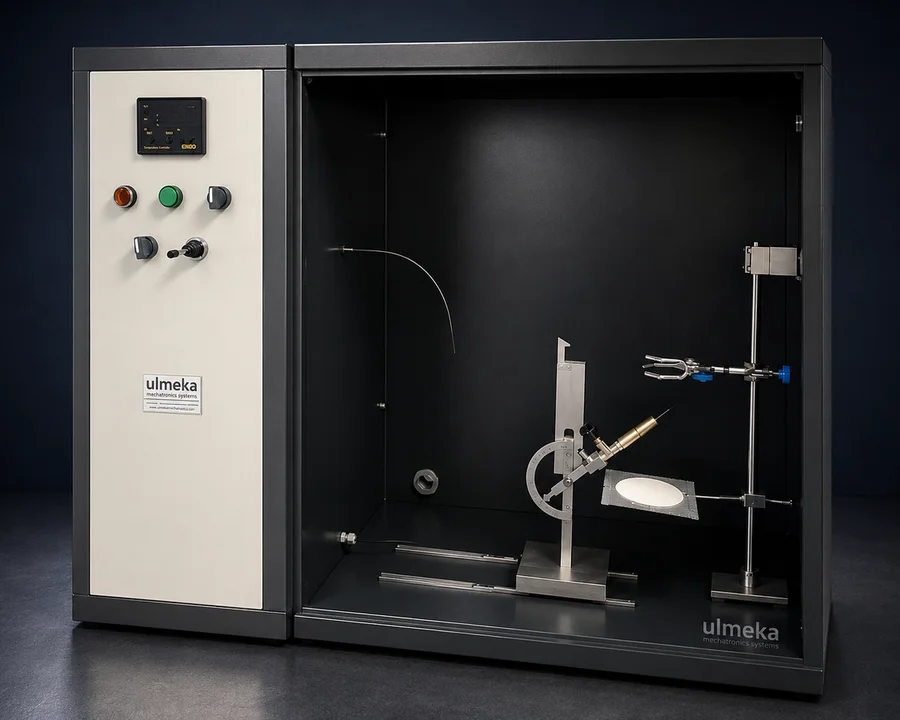
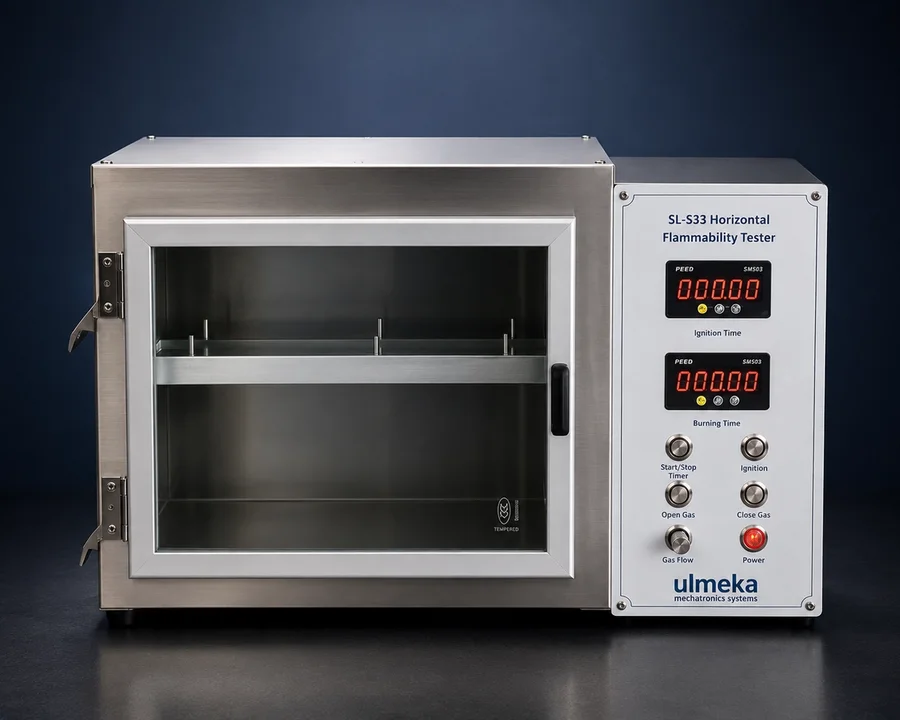
ULMEKA Mechatronics designs and manufactures the horizontal flammability test chamber used for this method — the equipment that turns the procedure above into a defined, repeatable test for DIN 75200, ISO 3795 and FMVSS 302 interior-material work. The chamber is built to the specimen and burner geometry the standard requires, with the U-shaped horizontal specimen holder and the defined burner arrangement reproduced as the standard's figure prescribes. Because the three standards share the method, one correctly configured chamber serves all three callouts.
The electrotechnical flammability world — glow-wire and needle-flame apparatus under IEC 60695 — is a separate equipment family, and which chamber a programme needs follows from which family the part belongs to. Where that is not obvious, the right configuration is settled against the standard the material is being tested to, at the quotation stage, before any chamber is built.
Related test systems.
Test Systems →
Frequently asked questions.
What does DIN 75200 actually measure?
DIN 75200 measures the horizontal flame-spread rate of automotive interior materials — dashboards, door panels, seat fabrics, headliners and similar cabin trim. A specimen is mounted horizontally in a U-shaped holder, a defined gas burner flame is applied to its free end for a set time, and after the burner is withdrawn the laboratory measures how long the flame front takes to travel between reference marks. From that distance and time it computes a linear burn rate in millimetres per minute. The standard does not grade smoke density, measure heat release, or certify that a part will survive a fire; it answers only how fast fire spreads along the material.
How is DIN 75200 related to ISO 3795 and FMVSS 302?
They are essentially the same method expressed in three documents: DIN 75200 is the German version, ISO 3795 the international version, and FMVSS 302 the United States federal motor-vehicle safety standard. All three are horizontal-burn methods for automotive interior materials and share the specimen geometry, horizontal mounting, burner application and burn-rate criterion. The differences lie in the surrounding framework — which body publishes the text and which regulatory regime cites it — so one correctly run test usually answers all three callouts, which is why material datasheets often list the trio side by side.
What is the pass criterion for DIN 75200?
There are two routes to a pass. Either the flame front travels between the reference marks slowly enough that the computed burn rate stays at or below a specified maximum, or the material self-extinguishes before the flame front reaches a reference mark at all. A material that goes out on its own, having never carried the flame across the measured zone, has met the intent because there is no spread rate left to exceed. The arithmetic of millimetres per minute only matters when the specimen keeps burning.
How does DIN 75200 differ from IEC 60695 flammability testing?
They belong to separate families built on opposite premises. DIN 75200 asks how fast fire spreads across a cabin material once it is alight, using a defined gas burner on a horizontally held specimen. IEC 60695 — the glow-wire tests, the needle-flame test and the UL-94 classes — asks whether an ignition source arising inside electrical equipment can propagate fire to its surroundings. The specimens, ignition sources and pass criteria differ, the standards are not interchangeable, and a pass under one says nothing about the other.
Which standard applies to a trim part that also contains electronics?
It carries results from both families, because neither speaks for the other. The cabin-facing trim material is assessed under the DIN 75200 / ISO 3795 / FMVSS 302 family for horizontal flame spread, while the electrotechnical part is assessed under IEC 60695. The correct method follows from what the part is, not from a general wish to show it resists fire, so a part that is both interior trim and electronics is tested under both.
Does ULMEKA build equipment for DIN 75200 testing?
Yes. ULMEKA Mechatronics designs and manufactures the horizontal flammability test chamber used for DIN 75200, ISO 3795 and FMVSS 302 interior-material work, built to the specimen and burner geometry the standard requires — the U-shaped horizontal specimen holder and the defined burner arrangement reproduced as the standard's figure prescribes. Because the three standards share the method, one correctly configured chamber serves all three callouts. The electrotechnical glow-wire and needle-flame apparatus under IEC 60695 is a separate equipment family.
ULMEKA engineers test systems
to specification.
If your requirement is outside this catalogue — custom chamber sizes, combined-standard integration, or tailored test profiles — talk to our engineering team.