


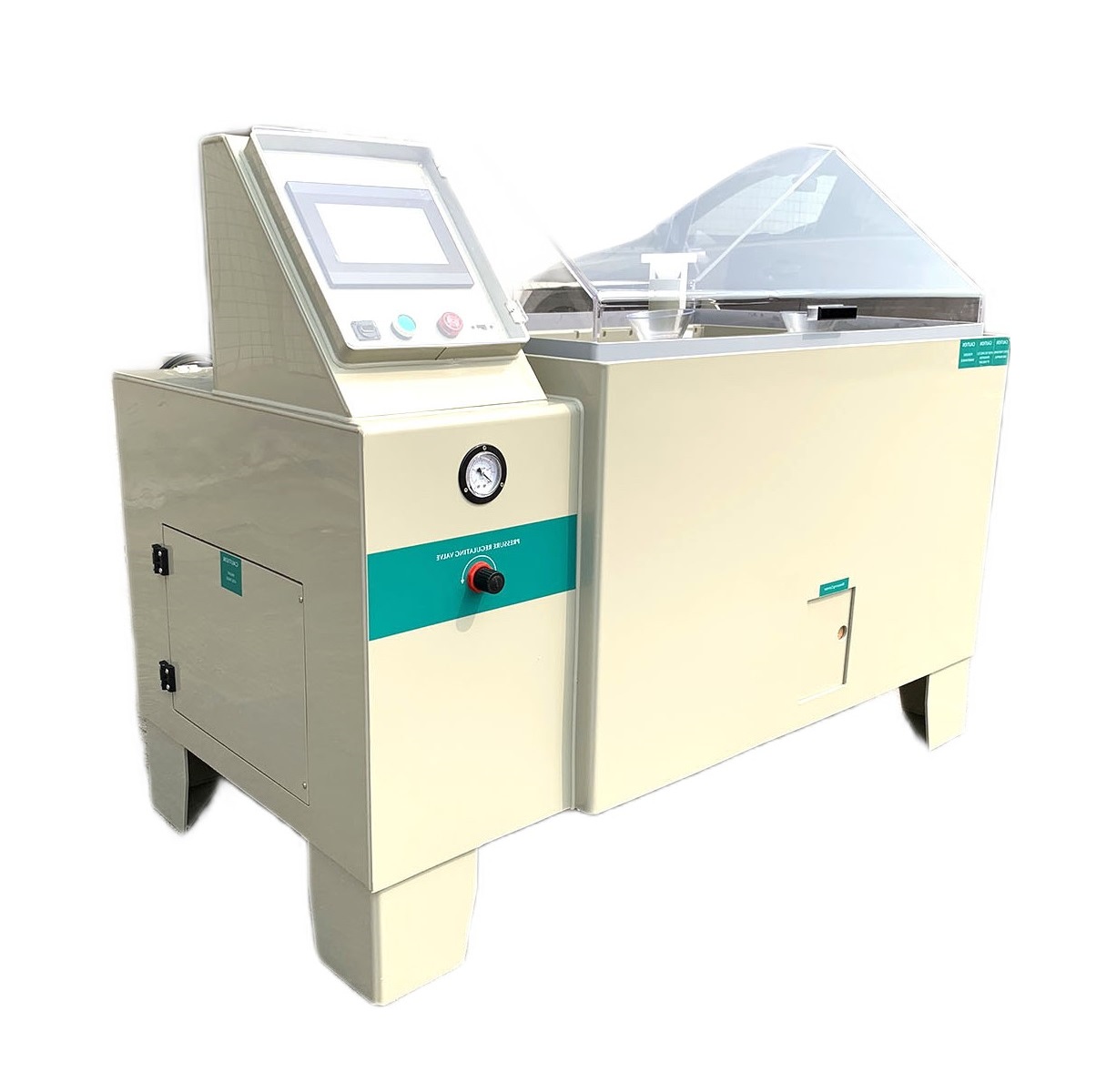

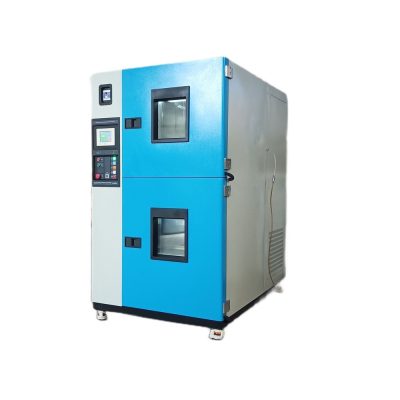
MIL-STD-810H (Method 509.7) Salt Fog
MIL-STD-810G (Method 509.5) Test Machine
The MIL-STD-810H (Method 509.7) Salt Fog Test Machine is designed to evaluate the durability of devices in corrosive salt environments. This machine is essential for testing the long-term reliability and durability of equipment used in marine, military, and industrial applications, where exposure to salt conditions can cause corrosion.
Test Objectives
- Corrosion Resistance: Measures the resistance of materials and coatings to corrosion caused by salt environments.
- Performance Degradation: Tests the performance loss in electronic and mechanical components due to salt fog exposure.
- Accelerated Aging: Simulates long-term exposure to salty environments for accelerated product durability testing.
1. Scope
This method evaluates the resistance of materials and protective coatings to salt-laden environments, particularly for equipment exposed to marine or high-salinity conditions.
- Purpose: To determine the effectiveness of protective coatings and finishes on materials, and assess the impact of salt deposits on their physical and electrical properties.
- Application: This test is primarily used for screening purposes, ensuring the durability of protective coatings, identifying quality control issues, and detecting design flaws in a short time.
- Limitations:
- The test does not replicate real-world exposure durations or the complex chemical composition of marine environments.
- It does not establish a direct correlation between salt fog exposure and corrosion caused by other media.
- Passing this test does not guarantee resistance to all corrosive conditions.
2. Tailoring Guidance
This section explains how to adapt the test method to specific requirements.
- Effects of Corrosive Environments:
- Corrosion Effects: Electrochemical corrosion, accelerated stress corrosion, and formation of acidic/alkaline solutions.
- Electrical Effects: Salt deposits can impair electrical performance, create conductive coatings, and corrode insulation.
- Physical Effects: Clogging or binding of mechanical components, paint blistering due to electrolysis.
- Test Sequence Considerations:
- If the same test sample is used for multiple tests, thorough cleaning is required after salt fog exposure.
- Salt fog testing is generally conducted after other environmental tests, such as humidity and fungus exposure.
3. Information Required
Before, during, and after testing, specific data must be collected.
- Pre-Test: The condition of the test sample, coating specifications, and sensor calibration should be documented.
- During Test: Chamber temperature, humidity, salt solution concentration, fallout rate, and pH must be recorded.
- Post-Test: Observations of corrosion, electrical failures, and mechanical deterioration are analyzed.
4. Test Process
This section details the experimental setup and procedure.
- Test Facility Requirements:
- The test chamber must maintain controlled humidity, temperature, and salt fog conditions.
- The salt solution should be composed of 5 ±1% NaCl.
- The chamber should allow consistent salt fog fallout between 1-3 ml per 80 cm² per hour.
- Test Setup & Execution:
- The sample is placed in the chamber at 35 ±2°C (95 ±3.6°F) for at least two hours before testing.
- The salt fog is continuously atomized into the chamber for 24 hours or per the test plan.
- The test item is then dried under controlled conditions for another 24 hours before repeating the cycle.
- Test Duration:
- A minimum of four 24-hour cycles (two wet and two dry) is recommended.
- Alternative test durations include 48 hours of continuous salt fog exposure followed by 48 hours of drying.
5. Analysis of Results
- The test results are analyzed for corrosion impact, electrical failures, and mechanical degradation.
- Any deviations from expected results are documented.
- Additional tests may be necessary for long-term durability assessments.
6. Reference Documents
- ASTM B117: Standard Practice for Salt Fog Testing.
- MIL-HDBK-310: Global Climatic Data.
- NATO STANAG 4370: Environmental Testing Standards.
Summary of MIL-STD-810H Method 509.7 – Salt Fog Test
The Salt Fog Test in MIL-STD-810H evaluates the resistance of equipment to marine and high-salinity environments.
Test Process:
- Salt Fog Exposure: A continuous 24-hour salt fog exposure followed by a 24-hour drying cycle, repeated for at least four cycles.
- Corrosion & Electrical Impact Assessment: The effects of salt deposits on materials and electronic components are analyzed.
Effects Evaluated:
- Corrosion of metals and protective coatings
- Electrical malfunctions due to salt deposits
- Mechanical degradation, including clogging and paint blistering
Final Assessment:
- The test data helps predict equipment durability in salt-laden environments.
- This test is crucial for military, industrial, and marine applications where exposure to salt fog is a concern.
Key Features
| Feature | Value / Description |
|---|---|
| Salt Solution Ratio | 5% NaCl solution (standard) |
| Temperature Range | 25°C – 55°C (programmable) |
| Spray Rate | 1 – 2 ml/80 cm²/hour (complies with MIL-STD-810H requirements) |
| Cabinet Volume | 100 L – 2000 L (available in various sizes) |
| Humidity Control | 30% – 98% relative humidity |
| Test Duration | 1 hour – 1000 hours (customizable test cycles) |
| Control System | Fully automated PLC-based control, user-friendly touch screen |
| Material | Stainless steel or corrosion-resistant polymer |
| Power Requirements | 220V AC, 50 Hz or 380V AC, 50 Hz |
| Monitoring and Logging | Real-time recording of test parameters, LAN/USB support |
| Optional Features | Automatic salt solution preparation system, camera-based test monitoring |
Application Areas
- Maritime: Testing the durability of ship equipment and marine vehicles in saltwater conditions.
- Military: Environmental reliability of devices used in coastal and maritime regions.
- Automotive and Electronics: Assessing the corrosion resistance of automotive parts, electronic devices, and coated surfaces.
For more detailed information about the MIL-STD-810H (Method 509.7) Salt Fog Test Machine and to place an order, please contact us!


