


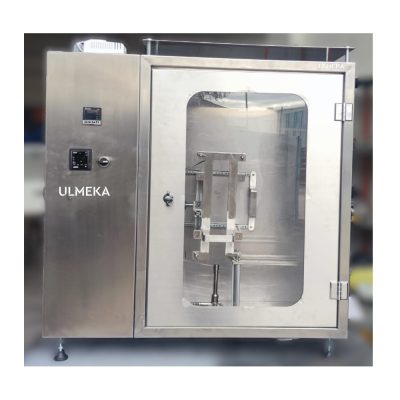

MIL-STD-810H (Method 505.7) Solar Radiation (Sunlight) Durability
MIL-STD-810G (Method 505.5) Test Machine
The MIL-STD-810H (Method 505.7) Solar Radiation Durability Test Machine is designed to evaluate the performance and durability of devices exposed to direct sunlight and ultraviolet (UV) radiation. This test is essential for ensuring environmental durability and long-term reliability of products in outdoor conditions.
1. Scope
1.1 Purpose:
This test has two primary objectives:
- To evaluate the heating effects of materials due to solar radiation.
- To determine the photochemical degradation (actinic effects) caused by prolonged exposure to sunlight.
1.2 Application:
This method is suitable for evaluating materials that may be exposed to solar radiation. It is particularly applied to materials used outdoors, in hot climates, where heat effects or ultraviolet (UV) degradation may impact performance.
1.3 Limitations:
- It does not cover all effects occurring in a real natural environment; therefore, it is recommended that materials be tested under real-world conditions.
- It is not suitable for materials used inside an enclosed enclosure; for such tests, Method 501.7 (High-Temperature Test) should be applied.
- It is not suitable for space applications, as solar radiation conditions differ in the space environment.
2. Tailoring Guidance
2.1 Selection of This Method
The necessity of the test should be determined by considering the likelihood of solar exposure during the material’s lifecycle.
2.1.1 Effects of Solar Environments
2.1.1.1 Heating Effects:
- Solar radiation can cause non-uniform thermal expansion, leading to deformation and stress in materials.
- Surface coatings and paints may degrade over time.
- Hardening, cracking, and color changes can occur in elastomer and plastic materials.
- Differences in the thermal expansion coefficients of metal components may cause mechanical systems to seize or loosen.
2.1.1.2 Photochemical (Actinic) Effects:
Prolonged exposure to sunlight, particularly ultraviolet (UV) radiation, can cause the following effects:
- Fading of colors in fabrics and plastics.
- Cracking and chalking of paint surfaces.
- Weakening of polymers due to photochemical reactions.
- Reduction in the strength of adhesives and elastomers.
2.1.2 Combination with Other Tests
- Method 501.7 (High-Temperature Test): Can be combined to understand heat-related effects.
- Method 502.7 (Low-Temperature Test): Can be used to evaluate the effects of temperature cycling.
- Method 507.6 (Humidity Test): Can be applied to assess the combined effects of solar radiation and humidity.
2.2 Selection of Test Procedure
Method 505.7 includes two different test procedures:
- Procedure I – Cycling Test: Tests the heating effects of solar radiation.
- Procedure II – Steady-State Test: Evaluates the photochemical degradation effects caused by prolonged solar exposure.
3. Information Required
3.1 Pre-Test Preparations
- The surface properties, color, and material type of the test specimen should be determined.
- The intensity and spectral distribution of solar radiation should be measured.
- The ambient temperature and airflow conditions for the test should be specified.
3.2 Data to be Collected During the Test
- Temperature-time variations in the test chamber.
- Surface temperature changes of the test specimen.
- Spectral distribution measurements of the radiation source.
3.3 Post-Test Data
- Levels of mechanical and chemical degradation of the material.
- Visual inspection results, such as color change, cracking, and surface degradation.
- Any functional changes in the material.
4. Test Process
4.1 Test Facility and Equipment
- Full-spectrum xenon arc lamps or metal halide (HMI) lamps should be used for testing.
- Airflow and temperature variations in the test chamber should be controlled.
- The radiation intensity in the test chamber should be set to 1120 W/m² ± 47 W/m².
4.2 Test Controls
- Airspeed should be in accordance with real-world conditions (1.5 – 3.0 m/s).
- The UV spectrum should be as close as possible to natural solar radiation.
4.3 Test Interruptions
- If the test equipment fails, the test should resume from where it left off.
- If the test specimen fails, the failure should be documented, and the test should be repeated.
5. Analysis of Results
Test results should be evaluated based on the following criteria:
- Physical Damage: Cracks, blistering, color changes.
- Functional Degradation: Failures in electrical or mechanical components.
- Chemical Effects: Changes in material composition.
6. References/Related Documents
- MIL-STD-810H
- NATO STANAG 4370, AECTP 230 (Climatic Conditions)
- ISO 9060 – Solar Energy Measurement Standards
- ASTM E824-05 – Solar Radiation Testing Standards
Test Objectives
- Heating Effects: Measures the effects of overheating caused by direct sunlight on devices.
- Photodegradation Effects: Tests whether UV radiation degrades the material structure and performance of the device.
Key Features
| Feature | Value / Description |
|---|---|
| UV Light Intensity Range | 0 – 1120 W/m² (simulating direct sunlight exposure) |
| Temperature Control Range | 25°C – 90°C (simulating high temperature effects) |
| Spectral Range | 295 nm – 800 nm (visible and ultraviolet light) |
| Test Duration | 1 hour – 1000 hours (programmable test cycles) |
| Cabinet Volume | 50 L – 500 L (various sizes to suit different product dimensions) |
| Control System | Fully automated PLC-based system with touch screen |
| Monitoring and Logging | Real-time monitoring and data logging (LAN/USB support) |
| Cooling and Ventilation | Strong cooling and air circulation system to balance harsh temperature conditions |
| Material | Stainless steel internal structure, UV-resistant insulation materials |
| Power Requirements | 220V AC, 50 Hz or 380V AC, 50 Hz |
| Optional Features | Humidity control system, UV spectral analysis device, camera-based test monitoring |
Application Areas
- Consumer Electronics: Durability of mobile devices and other products exposed to prolonged sunlight.
- Aerospace: UV resistance of aircraft parts and satellite components.
- Military: Environmental reliability of devices used in open fields and harsh outdoor conditions.
For more detailed information about the MIL-STD-810H (Method 505.7) Solar Radiation Durability Test Machine and to place an order, please contact us!


