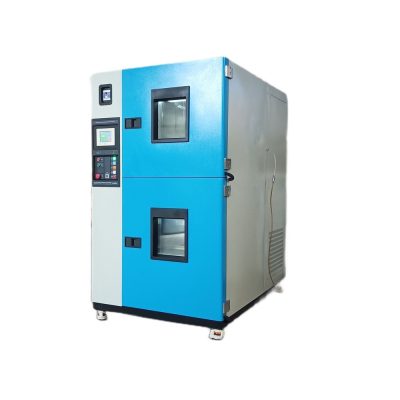
MIL-STD-810H (Method 503.7) Temperature Shock
MIL-STD-810G (Method 503.5) Test Machine
The MIL-STD-810H (Method 503.6) Temperature Shock Test Machine is designed to evaluate a device’s resistance to rapid temperature changes (temperature shock). This test measures how well the device withstands sudden increases or decreases in temperature.
1. Scope
1.1 Purpose:
This test is used to determine whether a material can withstand sudden ambient temperature changes without experiencing physical damage or performance loss. A “sudden change” is defined as an air temperature variation of more than 10°C (18°F) within 1 minute.
1.2 Application:
Normal environmental conditions:
- Transition between climate-controlled environments and extreme outdoor conditions (e.g., moving from an air-conditioned area to desert temperatures or from a heated shelter to a cold outdoor environment).
- Rapid ascent to high altitudes (e.g., a high-performance vehicle moving from a hot environment to a cold one).
- Air drops or cargo transportation from aircraft.
Safety and failure screening:
- Can be applied to detect safety issues and potential defects in materials that are expected to be exposed to sudden temperature changes less frequently.
1.3 Limitations:
- Cases where heat transfer within internal components is negligible due to sudden temperature changes (e.g., large-mass or insulated devices).
- Not suitable for performance evaluation after long-term temperature exposure (instead, Method 501.7 and 502.7 should be used).
- Materials exposed to temperature changes between liquids or the effects of flammable gases are not tested.
2. Test Tailoring Guidance
2.1 Selecting this method
This method is used in scenarios where temperature shocks are expected to occur in the material’s life cycle.
2.1.1 Effects of temperature shocks
- Cracking of glass bottles or optical materials
- Jamming or loosening of moving parts
- Cracking of solid particles in explosive materials
- Cracks between materials with different expansion coefficients
- Cracking of surface coatings
- Degradation of insulation materials
- Malfunction of electrical and electronic components
2.1.2 Sequencing with other test methods
This test can be better defined with data obtained from Method 501.7 (high temperature) and Method 502.7 (low temperature) tests.
2.2 Test procedure selection
The test method includes a single procedure but can be applied with four different variations:
- I-A: One-way shock (transition only to hot or cold side).
- I-B: Single-cycle temperature shock (from cold to hot and back).
- I-C: Multiple-cycle temperature shock (multiple temperature transitions).
- I-D: Transition from a controlled ambient temperature to extreme hot or cold.
2.3 Determining test levels and conditions
- Climatic conditions: Should be based on real service conditions.
- Exposure duration: Sufficient time must be provided for material temperature stabilization.
- Test item configuration: Should consider actual usage or logistics setup.
3. Information Required
3.1 Pre-test preparations
- Configuration of the test item
- Extreme temperature levels
- Temperature stabilization durations
- Type and direction of the shock
3.2 Data to be collected during the test
- Room temperature change records
- Temperature measurements on the material
- Transfer durations
- Test duration and exposure cycles
3.3 Post-test data
- Temperature change records
- Visual inspection results
- Condition and functionality of the tested component
- Influence from previous tests
4. Test Process
4.1 Test Facility and Equipment
- Two separate temperature chambers or a partitioned system allowing rapid temperature changes is required.
- The material transfer time must be within 1 minute.
4.2 Test Controls
- Temperature change rate must not deviate by more than 2°C.
- Airflow: Can affect the temperature transition of the test specimen.
4.3 Test Interruptions
- Camera failure: If test conditions are disrupted, the test should continue from the last successful test temperature.
- Material failure: If the material fails, the test should be restarted with a new specimen.
4.4 Test Implementation Procedures
- Procedure I-A: One-way temperature change.
- Procedure I-B: Single-cycle transition from cold to hot and back.
- Procedure I-C: Multiple cycles of extreme temperature changes.
- Procedure I-D: Transition from a controlled environment to extreme hot or cold conditions.
5. Analysis of Results
Test results are analyzed based on the following:
- Physical damage: Cracks, deformations, loss of sealing
- Functional degradation: Failures in electrical or mechanical components
- Chemical effects: Changes in material composition
6. References and Related Documents
- MIL-STD-810H
- NATO STANAG 4370, AECTP 300, Method 303
- MIL-HDBK-310 (Global Climatic Data)
Key Features
| Feature | Value / Description |
|---|---|
| Temperature Range | From +70°C to -40°C |
| Test Duration | Between 5 minutes and 2 hours |
| Test Method | Utilizes a temperature shock chamber |
| Test Result | Evaluates the device’s performance under rapid temperature changes |
Application Areas
- Electronic and Military Devices: Devices exposed to rapid temperature changes.
- Automotive and Aerospace: Vehicle and aircraft components subjected to varying temperature conditions.
For more information about MIL-STD-810H (Method 503.7) and to place an order, please contact us!