
IEC 60695 Fire-Hazard Testing: Glow-Wire, Needle-Flame, Flammability and Ball-Pressure.
IEC 60695 is not a single test. It is a family of standardised methods for assessing the fire hazard of electrotechnical products and the materials they are built from. The questions it answers are narrow and practical: how likely is a part to ignite when an electrical or thermal fault heats it, and once alight, how does it behave — does it self-extinguish, drip, or carry flame to its neighbours. The methods sit at the level of measurement procedure. They do not say which result a given product must achieve; the product safety standards do that, and they reference IEC 60695 rather than restate it. What follows is orientation for design and quality engineers, not a test-house manual.
The family is broad because fire hazard has several faces. A heated metal part inside a connector is a different threat from a small flame breaking out of a faulty component, and both differ again from a plastic enclosure softening until a live part shifts. IEC 60695 splits along those lines: separate method groups for glow-wire stress, needle flame, small laboratory flames that classify burning behaviour, and a heated-ball test for stability under temperature. Each group has its own apparatus and pass criterion.
The division of labour with the product standards
The cleanest way to hold the whole family in mind is to keep two roles apart. IEC 60695 defines how each property is measured — the apparatus, the application force, the acceptance criterion. The product safety standard defines which severity a given part must meet: which glow-wire temperature, which flammability class, which ball-pressure temperature.
The product standards that lean on IEC 60695 are the familiar ones. IEC 60335 governs household and similar appliances, IEC 60598 covers luminaires, IEC 60884 deals with plugs and socket-outlets, and IEC 62368-1 is the safety standard for audio, video, information and communication technology equipment. None of these redefines a glow-wire test or a flammability class; each reaches into IEC 60695 for the method and then states, for its own materials and parts, the severity that applies. So when a luminaire datasheet calls for a glow-wire temperature on a part, that number was chosen by IEC 60598, while the procedure behind it lives in the glow-wire parts of IEC 60695.
This matters when you read a requirement. A single line in a product standard — "the part shall withstand the glow-wire test at the temperature specified" — is really pointing at two documents at once. The temperature and the part come from the product standard; the wire geometry, the contact force, the duration and what counts as a pass come from IEC 60695. Read both.
Glow-wire: thermal stress from a hot part
The glow-wire methods (IEC 60695-2-10 through -2-13) simulate thermal stress from a hot source inside equipment — an overloaded resistor, a glowing connection, a poor contact running hot. An electrically heated wire loop is brought to a defined temperature, then pressed against the specimen with a defined force for a defined time. Severity is set by the wire temperature, and the temperatures cited across the family commonly include 550, 650, 750, 850 and 960 °C. The higher the temperature the more demanding the test, and the product standard decides which step a part must face.
Where the methods divide is in what they measure. Three related parameters share the glow wire but answer different questions.
GWEPT — the end-product test
The Glow-Wire End-Product Test (IEC 60695-2-11) is performed on the finished product or a representative part of it. It asks whether the real object, with its real geometry, ventilation and proximity of parts, withstands the heated wire. The answer depends on how the part is built, not only on what it is made of, which is exactly why it is a product test rather than a material property.
GWFI — a material property
The Glow-Wire Flammability Index (IEC 60695-2-12) is a material property, measured on standard specimens. It reports the highest temperature at which the material self-extinguishes within a set time and does not ignite the layer of tissue paper placed beneath it. Being a material figure, it is the sort of value that appears on a polymer datasheet, quoted alongside the grade.
GWIT — a material property
The Glow-Wire Ignition Temperature (IEC 60695-2-13) is also a material property. It characterises the ignition behaviour of the material, and it is commonly expressed as a temperature 25 to 30 K above the highest temperature at which the material does not ignite. It is easy to confuse with GWFI: both describe how the same material answers a hot wire, but they are not the same number, and reading one where the other is meant is a common slip.
Needle flame: a small flame from a fault
The needle-flame method (IEC 60695-11-5) addresses a different ignition source: not a hot part but a small open flame, the kind that can arise inside equipment from a fault condition. A small needle-shaped flame from a defined burner is applied to the specimen, simulating the effect of a brief flame breaking out internally. It is used where a product can credibly be exposed to such a flame from within. Like GWEPT, it is applied to the actual product or part rather than to a standard material coupon.
50 W and 500 W flames: classifying burning behaviour
Two methods use small, well-controlled laboratory flames to classify how a material burns rather than to test a finished product. They are the route by which the widely-known burning-behaviour classes are assigned. IEC 60695-11-10 uses a 50 W flame and covers the horizontal and vertical classifications: HB for the horizontal burning test, and V-0, V-1 and V-2 for the vertical test. IEC 60695-11-20 uses a more severe 500 W flame and covers the 5VA and 5VB classifications. These classes align with the widely-recognised UL 94 categories, which is why the same letters and numbers turn up on material datasheets the world over.
Two caveats. These are material classifications, measured on standard bars and plaques, not statements about a finished product. And the product standard, not the method, decides which class a given part must meet — the method standard only defines how a class is earned.
Ball-pressure: heat resistance of supporting parts
The ball-pressure test (IEC 60695-10-2) measures something the flame tests do not: dimensional stability under heat. A heated ball is pressed into the surface of the material at a defined temperature, and after a set time the diameter of the indentation is measured. The indentation must stay within a limit — commonly not exceeding 2 mm — for the material to pass. The concern is mechanical, not flammability: a part that holds live parts in place must not soften and deform at the temperatures it will see in service, because a part that creeps can let a live conductor move where it should not. The product standard sets the test temperature according to where the part sits and how hot it runs.
Material versus end-product
GWFI, GWIT and the UL-94-aligned flammability classes are material properties, measured on standard specimens and usually quoted on a datasheet. GWEPT and the needle-flame test apply to the actual product or part, with its real shape, wall thickness, openings and the arrangement of components around it. This line between a material property and an end-product result is where projects most often go wrong.
The consequence is what costs time: a good class on a material datasheet does not by itself prove the finished product passes. A plastic graded V-0 with a high GWFI is an encouraging start, but the end-product test can still be required, and the same material can behave differently once it is moulded thin, perforated for ventilation, or sat next to a heat source. Datasheet class informs the material choice; the end-product test, where the product standard calls for one, still has to be run.
Engineering implications when you plan
A few points decide whether fire-hazard testing goes smoothly:
- Start from the product standard, not the method standard. IEC 60335, 60598, 60884 or 62368-1 tells you which glow-wire temperature, which flammability class and which ball-pressure temperature each part must meet; IEC 60695 only tells you how each is measured. Pull the severities from there first.
- Separate material data from product tests in your evidence. A GWFI, a GWIT and a V-0 line from a datasheet are material evidence; GWEPT and needle-flame results are product evidence. Both may be needed, and one does not substitute for the other.
- Treat the material class as a starting filter, not a final answer. Use the datasheet class to shortlist materials, then confirm the finished part against whatever end-product test the product standard invokes.
- Take the ball-pressure temperature from the product standard. It is fixed by where the part sits and how hot it runs in service — it is not a property of the test rig, and you should not assume it from the bench.
- Expect to invoke more than one method. A single enclosure may need a glow-wire result, a flammability class and a ball-pressure result, each from a different part of IEC 60695, each with its own specimen and rig.
Where ULMEKA fits
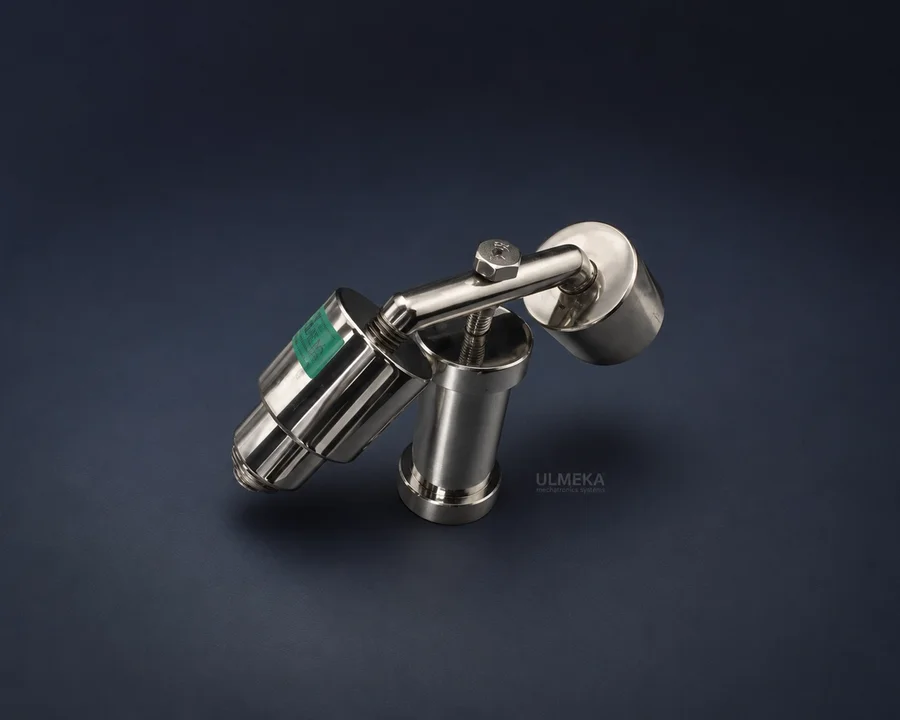
ULMEKA designs and manufactures the test equipment these methods require, built to the geometry and conditions the standards define: glow-wire test apparatus for the GWEPT, GWFI and GWIT procedures, needle-flame test equipment, ball-pressure heat-resistance rigs, and horizontal and vertical flammability test chambers for the HB and V-series and the 5VA/5VB classifications. Rigs come individually or in combination, with the exact configuration — wire temperatures, flame setup, ball-pressure conditions, chamber arrangement — settled at the quotation stage against the standard the product is being assessed to. For a product team the useful first step is simply a list of the methods and severities its product standard invokes; once that list exists, the selection mostly follows from it.
Passende Testsysteme.
Prüfsysteme →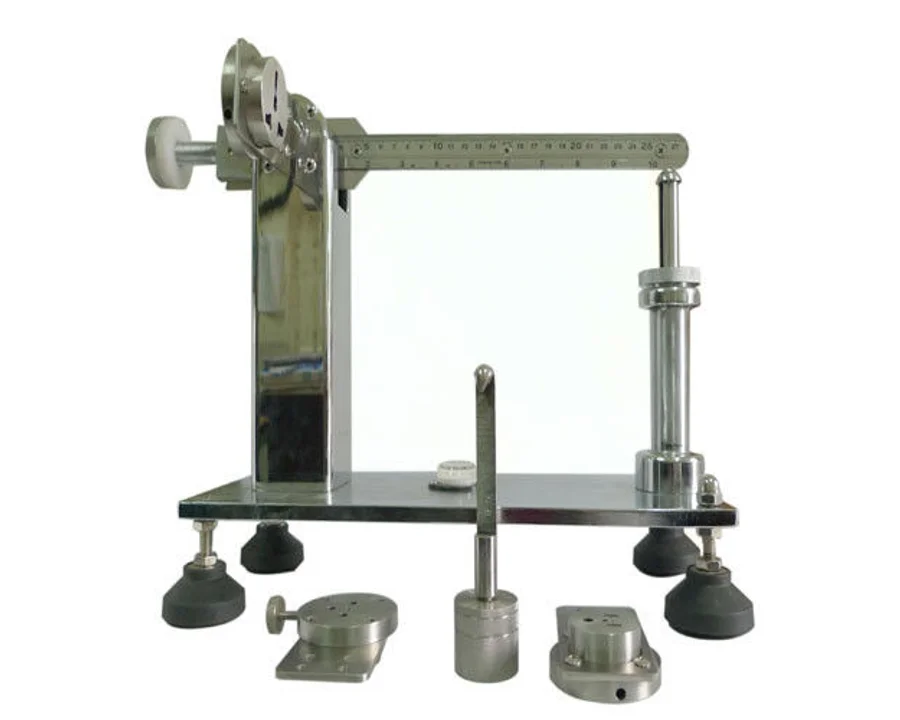
Häufig gestellte Fragen.
What is IEC 60695 and how does it relate to product safety standards?
IEC 60695 is a family of standardised methods for assessing the fire hazard of electrotechnical products and their materials: how likely a part is to ignite when an electrical or thermal fault heats it, and how it behaves once alight. It does not say which result a given product must achieve. Product safety standards such as IEC 60335 (household appliances), IEC 60598 (luminaires), IEC 60884 (plugs and socket-outlets) and IEC 62368-1 (audio, video and IT equipment) decide which glow-wire temperature, flammability class and ball-pressure temperature each part must meet, and reference IEC 60695 for how each is measured.
What is the difference between GWEPT, GWFI and GWIT?
All three use the heated glow wire but answer different questions. GWEPT, the Glow-Wire End-Product Test (IEC 60695-2-11), is performed on the finished product or a representative part, so its result depends on how the part is built. GWFI, the Glow-Wire Flammability Index (IEC 60695-2-12), is a material property: the highest temperature at which the material self-extinguishes within a set time and does not ignite the tissue paper beneath it. GWIT, the Glow-Wire Ignition Temperature (IEC 60695-2-13), is also a material property, commonly expressed as a temperature 25 to 30 K above the highest temperature at which the material does not ignite.
What do the flammability classes HB, V-0, V-1, V-2, 5VA and 5VB mean?
They classify how a material burns. IEC 60695-11-10 uses a 50 W flame and covers HB (the horizontal burning test) and V-0, V-1 and V-2 (the vertical test). IEC 60695-11-20 uses a more severe 500 W flame and covers the 5VA and 5VB classifications. These classes align with the widely-recognised UL 94 categories. They are material classifications measured on standard bars and plaques, not statements about a finished product, and the product standard decides which class a given part must meet.
Does a good flammability class on a material datasheet prove the finished product passes?
No. GWFI, GWIT and the UL-94-aligned flammability classes are material properties measured on standard specimens and quoted on a datasheet, whereas GWEPT and the needle-flame test apply to the actual product or part with its real shape, wall thickness, openings and surrounding components. A plastic graded V-0 with a high GWFI is an encouraging start, but the end-product test can still be required, and the same material can behave differently once moulded thin, perforated for ventilation, or placed next to a heat source. The datasheet class informs the material choice; it does not remove the need to run the end-product test where the product standard calls for one.
What does the ball-pressure test measure?
The ball-pressure test (IEC 60695-10-2) measures dimensional stability under heat rather than flammability. A heated ball is pressed into the material surface at a defined temperature, and after a set time the indentation diameter is measured; it must stay within a limit, commonly not exceeding 2 mm, for the material to pass. The concern is that a part holding live parts in place must not soften and deform at service temperatures, because a part that creeps can let a live conductor move where it should not. The product standard sets the test temperature according to where the part sits and how hot it runs.
When is the needle-flame test used?
The needle-flame method (IEC 60695-11-5) addresses a small open flame rather than a hot part, the kind of flame that can arise inside equipment from a fault condition. A small needle-shaped flame from a defined burner is applied to the specimen to simulate a brief flame breaking out internally, and it is used where a product can credibly be exposed to such a flame from within. Like GWEPT, it is applied to the actual product or part rather than to a standard material coupon.
ULMEKA konstruiert Prüfsysteme
nach Spezifikation.
Wenn Ihre Anforderung über diesen Katalog hinausgeht — kundenspezifische Kammergrößen, Integration kombinierter Normen oder angepasste Prüfprofile — sprechen Sie mit unserem Ingenieurteam.