



IP Test Room and Water Resistance Tests
An IP (Ingress Protection) test room is a specialized testing environment used to measure the resistance of devices to water, dust, and other external factors. IP codes consist of two digits that determine the protection levels of devices. The first digit indicates the level of protection against dust, while the second digit indicates the level of protection against water. IP tests are widely applied in industrial products, electronic devices, transportation equipment, and the automotive industry, especially for products that require waterproofing and dustproofing.
IP Test Levels
IP tests consist of a series of tests that determine how resistant a device is to various external factors. The IP code consists of two digits. The first digit shows the device’s resistance to solid objects (e.g., dust), while the second digit shows its resistance to water. Here are detailed explanations of the IP tests:
IPX1 Test:
IPX1 tests the device’s resistance to vertically falling water droplets. In this test, water droplets with a diameter of 2.5 mm are dropped onto the device from all sides for 10 minutes. It is checked whether any water enters the device. IPX1 provides a basic level of protection against water droplets.
IPX2 Test:
IPX2 tests the device’s protection against water droplets but allows the device to be exposed to water at inclined angles. In this test, the device is exposed to water droplets with a diameter of 2.5 mm at a 15° angle for 10 minutes. This shows that the device is resistant to water in light rain or when tilted.
IPX3 Test:
IPX3 provides protection against water splashes at a 60° angle. In this test, the device is exposed to a 3 mm water jet for 5 minutes. The device should not be damaged by the water or allow water to enter. IPX3 demonstrates the device’s resistance to rain and water splashes.
IPX4 Test:
IPX4 tests the device’s protection against water splashes from all directions. In this test, the device is exposed to a 1 mm water jet for 5 minutes. The device should not allow water to enter and its functionality should not be affected. IPX4 shows that the device is protected against light water splashes.
IPX5 Test:
IPX5 determines the device’s resistance to water jets. In this test, a water jet with a diameter of 6.3 mm is applied to all sides of the device for at least 3 minutes at a specific pressure (12.5 L/min). The device should not allow water to enter or show minimal impact during the test. This test demonstrates protection against water splashes and low-pressure water.
IPX6 Test:
IPX6 tests the device’s resistance to stronger water jets. The device is exposed to a 12.5 mm water jet for 3 minutes at high pressure (100 L/min). The device should not allow water to enter or damage its internal mechanisms. IPX6 shows that the device is resistant to harsher water conditions.
IPX7 Test:
IPX7 tests the device’s resistance to immersion in water. The device is submerged in water at a depth of 1 meter for 30 minutes, and it is verified that no water enters the device. This test shows that the device is resistant to short-term immersion in water.
IPX8 Test:
IPX8 tests the device’s resistance to prolonged submersion in water. Similar to IPX7, but in this test, the device is submerged for a specified depth and duration as indicated by the manufacturer. The device is resistant to long-term immersion in water.
IPX9K Test:
IPX9K tests the device’s resistance to high-pressure and high-temperature water jets. The device is exposed to water at 80°C at a flow rate of 14-16 L/min with a pressure of 80 bar from a distance of 4-6 meters. This test confirms that the device is resistant to water in harsh industrial environments.
Other Tests Conducted in an IP Test Room
IP4X Test:
This test prevents the entry of solid objects larger than 1 mm. It provides protection against dust.
IP6X Test:
This test ensures that the device is fully protected from dust. In the dust test, the device is operated in a dusty environment, and no dust is allowed to enter the device.
Features and Applications of the Test Room
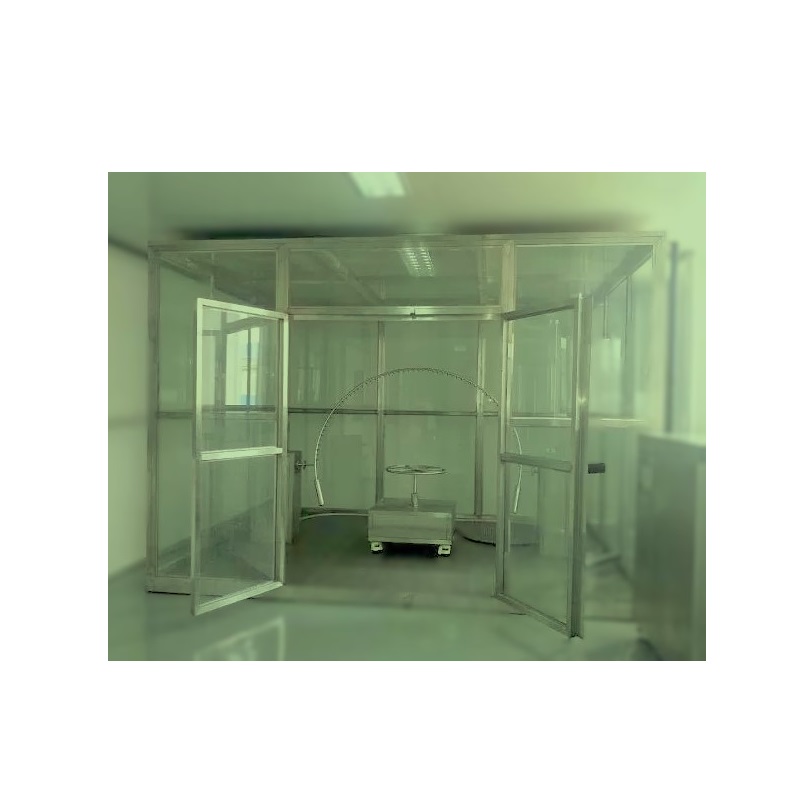
The IP test room is designed to ensure that tested devices are best protected from external factors. These rooms are specially configured to apply water at the correct pressure and angle. In an IP test room, devices are tested in a safe and controlled environment according to specific standards.
IP tests play a critical role in the design and production processes of devices that are intended for outdoor use, industrial equipment, automotive components, and military technologies. These tests validate the durability of the products and ensure that they are developed to extend their service life.
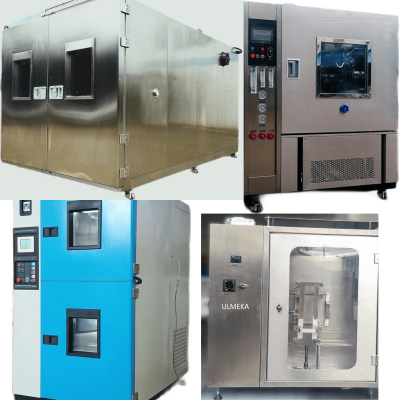
As ULMEKA Mechatronics Ltd. Co., we design and manufacture all testing equipment according to relevant standards and your specific needs. We also take into account the dimensions you specify and produce these testing devices in room or cabinet sizes according to your requirements. You can contact us for custom-designed or custom-sized test devices according to your needs.


